

.png)
.png)
.png)
.png)

.png)
If your dentist recently looked at your wisdom teeth and suggested taking them out, even though nothing hurts, you're not alone in feeling confused by that advice.
It's a common moment for teens, young adults, and parents sitting in that dental chair together. A tooth that feels fine on the surface can still be quietly affecting the teeth, gums, or bone around it.
Pain is not a reliable way to judge whether wisdom teeth are healthy or safe to keep. If you're wondering why remove wisdom teeth when they aren't causing pain, the reason often comes down to problems developing below the surface.
Third molars can sit trapped under the gums, press against neighboring teeth, or trap bacteria before you feel anything. That's why dentists rely on dental x-rays and a hands-on wisdom teeth evaluation rather than waiting for discomfort to show up.
This doesn't mean every painless wisdom tooth needs to come out. Some fully erupted, easy-to-clean wisdom teeth can be monitored safely over time. The right call depends on your specific mouth, your x-ray findings, and how much risk your dentist sees ahead.
Key Takeaways
- Painless wisdom teeth can still be impacted, partially erupted, or damaging nearby teeth without any warning signs.
- Dental x-rays and a professional evaluation, not pain, are what actually confirm whether a wisdom tooth is safe to keep.
- Fully erupted, cleanable wisdom teeth may be monitored, while impacted or partially erupted ones often carry ongoing risk.
Why No Pain Does Not Rule Out a Problem
Some wisdom tooth problems can develop without noticeable pain, which is why symptoms alone may not show whether a third molar is healthy. By the time you feel soreness or swelling, damage to the tooth, gums, or bone may have been building for months or longer. That's the main reason dentists don't use comfort alone as a safety test.
Why Wisdom Teeth Are Easy to Miss When Brushing and Flossing
Wisdom teeth sit at the very back of your mouth, where a toothbrush and floss barely reach. Even people with great oral health habits often can't fully clean around these teeth. Food particles and bacteria can build up in that hidden space for a long time before you notice any symptoms.
What Dental X-Rays Can Show Before Symptoms Start
Using advanced technology, a dental x-ray can reveal what your eyes and fingers cannot. It shows whether a wisdom tooth is angled toward another tooth, trapped under bone, or pressing on nearby tooth roots. It can also flag early bone loss or a cyst forming near the tooth, long before any of that would cause pain.
What Happens During a Wisdom Teeth Evaluation
A wisdom teeth evaluation usually combines a visual exam with x-ray imaging. Your dentist checks the angle of each tooth, how much of it has broken through the gum, and how it lines up with your second molars. This exam happens during routine dental checkups, so it often gets caught before you'd ever notice a problem yourself.
Silent Risks That May Affect Nearby Teeth and Gums
Wisdom teeth that stay hidden or partly hidden under the gums can cause damage without any pain to warn you. The risk usually comes down to two situations: impacted wisdom teeth trapped under bone or gum tissue, and partially erupted wisdom teeth that leave an open flap of gum where bacteria can collect.
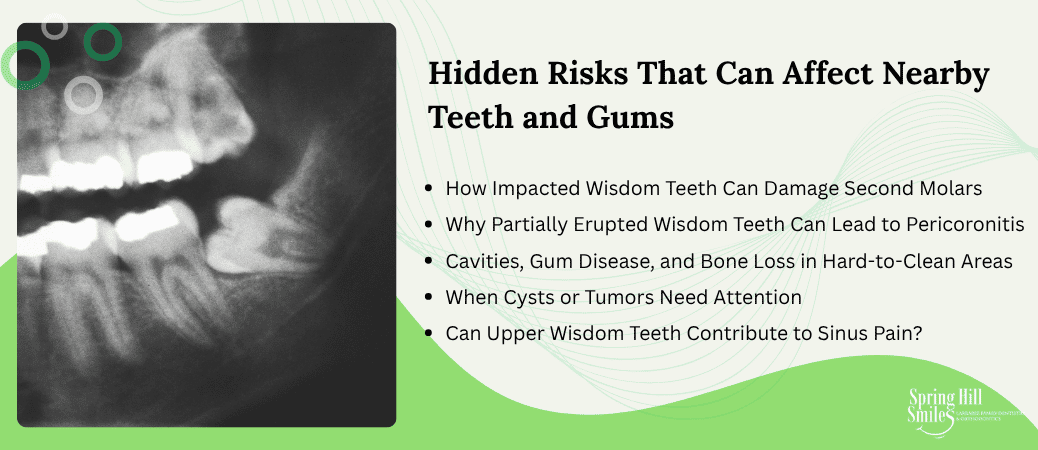
How Impacted Wisdom Teeth Can Damage Second Molars
Impacted wisdom teeth can press directly against the second molars in front of them. That pressure can wear down enamel, crowd the roots, or in some cases lead to root resorption, where the pressure slowly breaks down the neighboring tooth's root structure. This pressure and the difficulty cleaning that area together raise the risk of cavities and gum inflammation on the second molar itself.
Some patients feel nothing while this is happening. Others notice jaw stiffness, mild swelling, or a dull ache that comes and goes. Either way, the damage is often visible on an x-ray before it becomes a bigger issue.
Why Partially Erupted Wisdom Teeth Can Lead to Pericoronitis
A partially erupted wisdom tooth leaves a flap of gum tissue covering part of the crown. Bacteria can get trapped underneath that flap, leading to pericoronitis, a gum infection around the tooth that causes swelling, tenderness, and sometimes a bad taste in the mouth. This gum infection can flare up and settle down repeatedly, which sometimes gives a false sense that the problem has resolved on its own.
Cavities, Gum Disease, and Bone Loss in Hard-to-Clean Areas
The tight space around a partially erupted or impacted wisdom tooth is difficult to keep clean, even with careful brushing. Over time, this can lead to tooth decay, gum disease, and gradual bone loss around the tooth. Left unaddressed, these issues can spread to affect the second molar next to it, not just the wisdom tooth itself.
When Cysts or Tumors Need Attention
Fluid-filled cysts can form around an impacted wisdom tooth, and while rare, tumors can develop in that same tissue over time. These growths can slowly damage the jawbone if they go unnoticed, since they usually don't cause pain in early stages. The American Association of Oral and Maxillofacial Surgeons notes that this kind of silent progression is one reason routine evaluation matters, even for wisdom teeth that seem to be causing no trouble.
Can Upper Wisdom Teeth Contribute to Sinus Pain?
Upper wisdom teeth sit close to the sinus cavities, so infection or inflammation in that area can sometimes feel like sinus pressure or sinus pain. Patients occasionally describe this as a dull ache near the cheekbones or a stuffy feeling that doesn't match a typical sinus infection. If you're dealing with facial pressure that doesn't clear up the way a cold or allergy would, it's worth asking your dentist whether an upper wisdom tooth could be part of the picture.
When Can You Keep Wisdom Teeth Instead?
Wisdom teeth can sometimes stay in your mouth for life without causing harm. This is most likely when a tooth has fully broken through the gum, sits in a normal position, and can be reached easily with a toothbrush and floss.
Signs a Fully Erupted Wisdom Tooth May Be Suitable for Monitoring
A wisdom tooth that has fully erupted, lines up well with the teeth around it, and shows no decay or gum irritation on x-rays is often a candidate for monitoring instead of removal. Your dentist will usually recheck it at future dental checkups to make sure nothing changes. This approach only works if you can keep the tooth clean and your dentist has a clear view of it during exams.
How Crowding and Bite Problems Factor Into the Decision
Wisdom teeth can contribute to crowding or bite problems in some patients, though this isn't guaranteed for everyone. When a wisdom tooth is pushing against neighboring teeth or throwing off your bite, that pressure becomes part of the case for removal. If your teeth are well-spaced and your bite feels stable, crowding risk carries less weight in the decision.
What to Consider After Braces or Other Orthodontic Work
If you've completed orthodontic treatment, your orthodontist and dentist may watch wisdom teeth closely to see whether they could shift teeth out of their corrected positions. This doesn't mean every wisdom tooth threatens orthodontic results after braces or other orthodontic work.
It means your dental team will factor in your bite stability and tooth alignment before deciding whether keeping the wisdom teeth makes sense. Anyone weighing crowding concerns without extraction might also look into Invisalign options for crowded teeth as part of that broader conversation with their provider.
What to Expect If Removal Is Recommended
Wisdom tooth removal ranges from a straightforward office procedure to a more involved surgical extraction, depending on how the tooth sits in your jaw. Your dentist or an oral surgeon will explain which category applies to your case after reviewing your x-rays.
Simple Extraction vs. Surgical Extraction
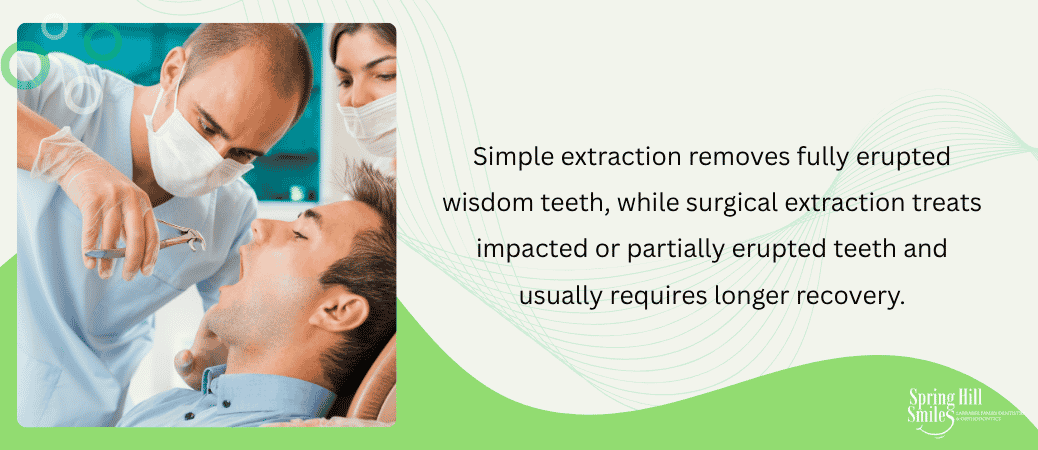
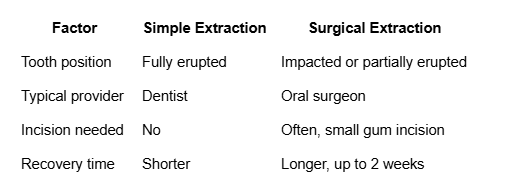
A simple extraction is used for a wisdom tooth that has fully erupted and has an accessible root structure, similar to removing any other visible tooth. Surgical extractions are needed for impacted or partially erupted teeth, since the dentist or oral surgeon needs to access the tooth through the gum or bone.
How Local Anesthesia and Sedation Support Comfort
Local anesthesia numbs the area around the tooth so you won't feel pain during the procedure itself. Many patients also choose sedation, which helps with anxiety and keeps you relaxed through a surgical extraction. If dental anxiety has kept you from scheduling this kind of care, it helps to talk with your provider about sedation dentistry options ahead of time.
Recovery, Soft Foods, and Dry Socket Prevention
Most people recover within three to four days, though full healing can take up to two weeks. Sticking to soft foods for the first few days protects the extraction site while it heals. Avoiding straws and vigorous rinsing lowers your risk of dry socket, a painful condition where the healing blood clot comes loose too early.
When Jaw Stiffness or TMJ Symptoms Need Follow-Up
Mild jaw stiffness after surgery is common and usually fades within a week or two. If stiffness lingers, or if you notice clicking, popping, or pain near your jaw joint, mention it to your dentist, since this could point to temporomandibular joint (TMJ) irritation that benefits from follow-up care.
A Personalized Plan Protects Your Long-Term Oral Health
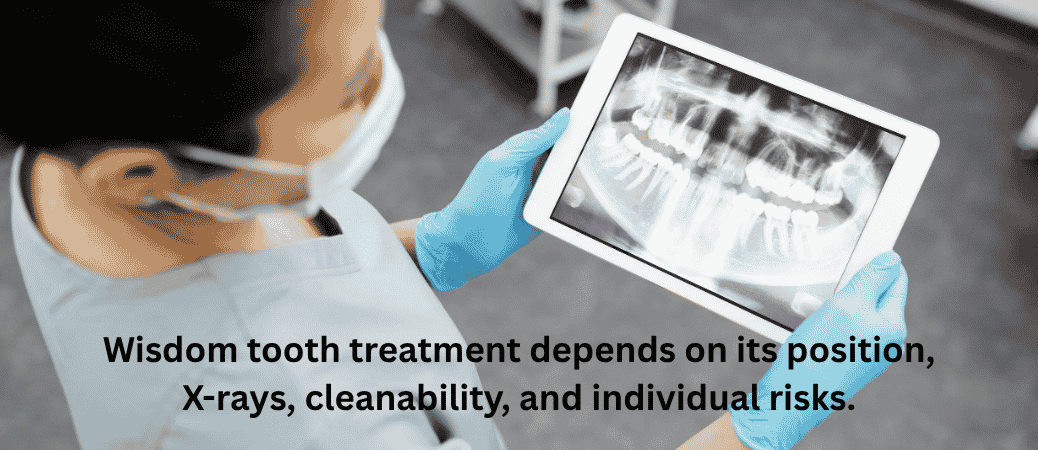
At Spring Hill Smiles, your wisdom teeth are evaluated based on your individual needs rather than a one-size-fits-all approach. Your dental team considers tooth position, cleanability, x-ray findings, and your personal risk factors before recommending continued monitoring or wisdom teeth removal.
This personalized approach helps you understand why treatment may or may not be necessary and make an informed decision about your long-term oral health.
If it's been a while since your last check, scheduling a wisdom teeth removal evaluation gives you a clear, current picture instead of guesswork. Pairing that with your regular visits for general dentistry keeps your whole mouth on track, wisdom teeth included.
Frequently Asked Questions
Should I remove my wisdom teeth if they do not hurt?
Not automatically. The decision depends on your x-ray findings, whether the tooth is impacted, and how easily you can clean it, not on whether you feel pain right now. Ask your dentist to walk you through your specific imaging before deciding.
Can I keep wisdom teeth that are fully erupted and easy to clean?
Yes, in many cases. Fully erupted wisdom teeth that sit in a normal position and don't trap food or bacteria can often be monitored at regular dental checkups instead of removed.
Do wisdom teeth need to be removed if they are not impacted?
Not always. A wisdom tooth that has erupted fully, functions normally, and shows no decay or gum problems on x-rays may be safe to keep, though your dentist will confirm this with periodic monitoring.
Is wisdom teeth removal painful?
Local anesthesia keeps you numb during the procedure, and sedation is available for added comfort during more involved surgical extractions. Some soreness and swelling are normal afterward, but this usually improves within a few days with over-the-counter pain relief.
Why do dentists use X-rays to evaluate painless wisdom teeth?
Dental x-rays show what's happening beneath the gum line, including impaction, pressure on nearby teeth, and early bone changes that you can't feel or see. This imaging catches problems long before pain would ever alert you to them.
Can wisdom teeth cause problems after braces?
Wisdom teeth can put pressure on nearby teeth after orthodontic treatment in some patients, though this isn't guaranteed for everyone. Your orthodontist and dentist will factor in your bite stability and alignment history when deciding whether to monitor or remove them.
.png)
.png)





.webp)