


When comparing full mouth reconstruction vs All-on-X, the deciding factor is often how many of your natural teeth can be kept with a good long-term outlook. If most teeth are healthy enough to be saved, full mouth reconstruction is usually the better fit. If most or all teeth in one jaw need to be removed, All-on-X may offer a more predictable solution..
Full mouth reconstruction fits you when most of your teeth can be saved and rebuilt, and All-on-X fits you when an arch has so few healthy teeth left that replacing the whole arch with a fixed implant bridge is more predictable. Many people end up with a blend of both, with one arch rebuilt tooth by tooth and the other replaced.
If you have heard two very different plans from two offices, that can feel unsettling. It often means each office weighed tooth prognosis, bone, and bite a little differently. Once you know what each plan is built to solve, you can ask sharper questions and judge which recommendation matches your mouth.
Key Takeaways
- How many teeth can be predictably kept decides which path fits.
- Bone, gum health, and bite force can shift the plan after 3D imaging.
- Same-day teeth are temporary, and the final bridge comes months later.
What Is the Difference That Drives the Decision?
Full-mouth reconstruction is a custom treatment plan, and All-on-X is one specific method for replacing a full arch. Reconstruction works tooth by tooth with whatever tools each tooth needs. All-on-X removes the remaining teeth in an arch and attaches one fixed bridge to a set of implants.
Full-Mouth Reconstruction Keeps Teeth That Can Be Rebuilt
A full-mouth reconstruction, sometimes called a full mouth restoration, starts with one question for each tooth: can this tooth be saved and trusted for years? Teeth that pass are kept and rebuilt. Teeth that fail are removed and replaced.
The tools in a reconstruction plan can include:
- Crowns for cracked, worn, or heavily filled teeth
- Onlays when part of the chewing surface is lost but the tooth is still strong
- Bridges for small gaps between healthy teeth
- Veneers when the front teeth need shape or color changes and the bite allows it
- Individual dental implants for single missing teeth
- Gum treatment and bite correction
The big benefit is that you keep your own roots. A natural tooth has nerve fibers around it that sense pressure, which helps you chew without thinking about it. Implants do not have that same feedback.
All-on-X Replaces a Failing Arch with a Fixed Bridge
All-on-X is a full-arch replacement. For patients who still have failing teeth in the affected arch, those teeth may need extraction before implants are placed. The implants then support a fixed full-arch bridge that patients do not remove at night.
The best-known version is All-on-4 dental implants. With All-on-4, two implants go straight up and down in the front of the jaw. The two back implants are tilted so they can reach farther back without hitting the sinus or the nerve in the lower jaw. "All-on-X" is the broader name for the same idea with four, five, six, or more implants.
This approach makes sense when patching tooth after tooth no longer works. If you have had crowns break again and again, or gum disease has loosened many teeth, one stable bridge can be more predictable than many separate repairs.
Factor
Full Mouth Reconstruction
All-on-X
Natural teeth kept
Yes, when healthy
No, arch is cleared
Main tools
Crowns, onlays, bridges, single implants
4 to 6+ implants, one bridge
Visits
Several, in stages
Fewer surgeries per arch
Cleaning
Brush and floss like natural teeth
Clean under the bridge
Best fit
Mixed problems, savable teeth
Most teeth missing or failing
Can All-on-X Be Part of a Reconstruction Plan?
Yes. All-on-X is one tool a reconstruction can use. Think of reconstruction as the full blueprint and All-on-X as one way to build one section of it.
A common example: your upper teeth are loose from gum disease and bone loss, while your lower teeth are mostly sound. A careful plan might use All-on-X on top and crowns plus one or two implants on the bottom. Both arches then have to be designed together so they meet evenly when you bite.
Be cautious when every patient at an office gets the same answer. A good plan comes after the exam and imaging. It should explain why each tooth is being kept or removed.
Which Path Fits the Teeth You Have Now?
Your current teeth decide the starting point. If most teeth can be kept with confidence, reconstruction leads. If most teeth in an arch are failing, All-on-X leads. And your two jaws can land on different sides of that line.
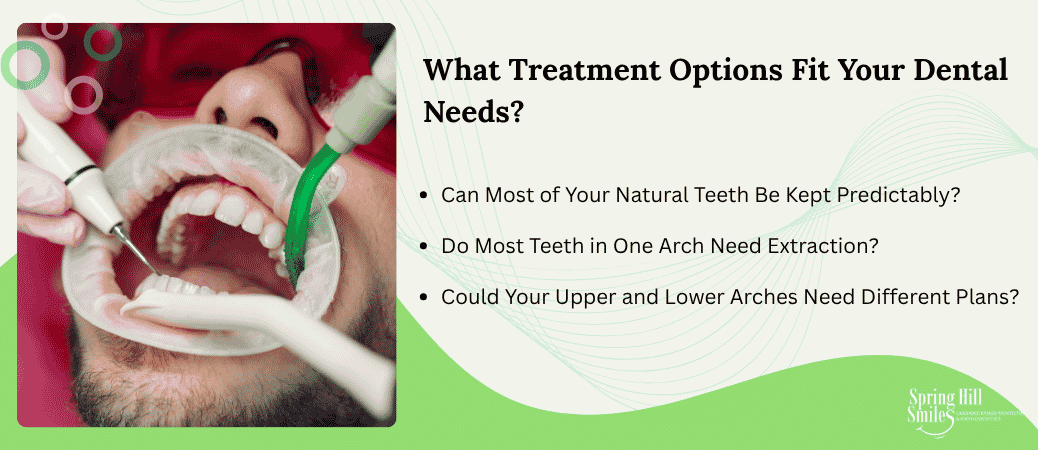
Can Most of Your Natural Teeth Be Kept Predictably?
A tooth is worth keeping when it has enough healthy structure above the gum, a solid root, and good bone and gum support around it. Your dentist checks each tooth with X-rays, gum measurements, and a look at how hard it works when you chew.
Reconstruction usually fits if you have:
- Worn, flat teeth from grinding
- Old crowns and fillings that need replacing
- A few missing teeth with healthy neighbors
- A bite that has collapsed and needs bite correction
These are some of the common problems full mouth reconstruction can fix. If several teeth are already missing or cannot be saved, understanding your options for replacing multiple missing teeth can help you compare implants, bridges, and dentures.
"Can be saved" and "should be saved" are different. A tooth with a cracked root or deep infection might be treatable in some cases, but keeping it is not always the best long-term choice. If it compromises your bite or overall oral health, replacing it may provide a more stable result.
Do Most Teeth in One Arch Need Extraction?
When most teeth in one jaw are loose, broken, or infected, All-on-X often becomes the more predictable choice. Trying to save two or three weak teeth among many failing ones can lead to years of repairs and more tooth loss.
Signs that point toward a full-arch plan:
- Gum disease has weakened support around many teeth
- Repairs keep breaking or failing
- Several teeth have deep cracks or repeat infections
- A removable denture feels loose and you want something fixed
Reviewing the key factors for All-on-4 candidacy can also help you understand how bone health, remaining teeth, and overall oral health affect treatment planning.
The choice between All-on-4 and All-on-6 implants comes later, based on your available bone, bite, and individual treatment needs.
Could Your Upper and Lower Arches Need Different Plans?
Yes, and this happens a lot. Your upper jaw might have softer bone and only a few failing teeth left. Your lower jaw might still have strong teeth that only need crowns.
In that case, a split plan makes sense. You might get All-on-X on top and keep your lower teeth with crowns and a single implant. The catch is force. Healthy natural teeth bite harder than a denture does, so the upper bridge has to be built to handle that load.
Ask your dentist to show you each arch separately on the plan. That makes it easier to see which teeth are being saved, which are being replaced, and why. Dental implants can then go only where they are needed.
What Could Change the Initial Recommendation?
Your first recommendation can change after imaging. Bone shape, gum health, bite force, and how firmly implants hold on surgery day all affect the final plan.
How Do Bone and Gum Health Affect Candidacy?
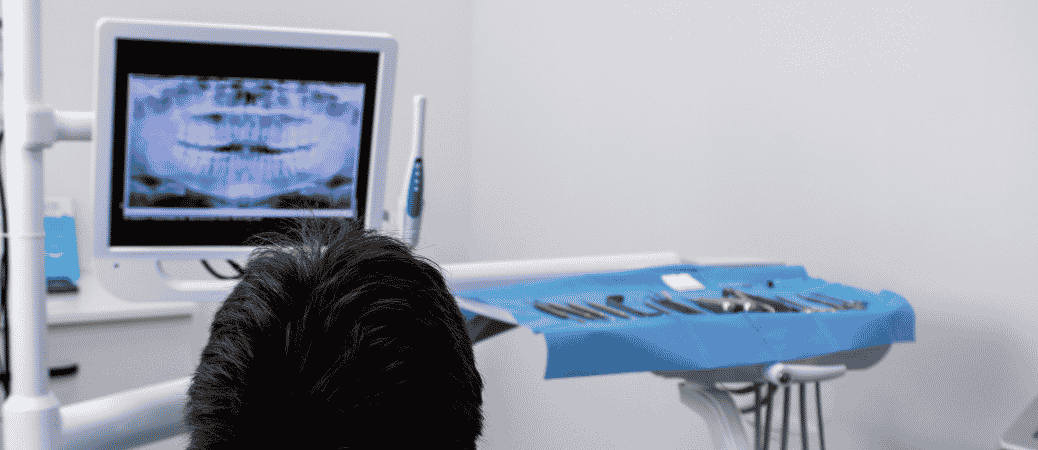
A proper implant consultation should include CBCT 3D imaging when detailed bone assessment is needed. This scan shows your jawbone height and width, along with the location of nearby sinuses and nerves. With modern technology, your dentist can assess these structures and plan implant placement more precisely than with traditional 2D X-rays alone.
Bone loss happens after teeth are lost, after long-term infections, and after years of wearing a loose denture. The more bone is gone, the harder it may be to place implants in the ideal position.
Gums matter too. Active gum disease needs treatment before implant placement. If your gums are inflamed, your dentist may recommend periodontal treatment and a healing period before moving forward with implants.
When Are Four Implants Enough and When Are More Needed?
Four implants may provide sufficient support for a full-arch bridge when bone quality, implant positioning, and bite forces are favorable. Your dentist determines whether four, five, six, or more implants are appropriate based on your jawbone anatomy, treatment goals, and prosthetic design.
Your implant count may go up when:
- You clench or grind your teeth
- Your arch is long or wide
- Your upper jaw bone is soft
- You will bite against natural teeth on the other jaw
- You want the bridge in sections that are easier to repair
One finite element study comparing All-on-4, All-on-5, and All-on-6 in a thin lower jaw modeled how stress spreads across the bone with each design. More implants are a structural choice tied to your bone and bite, and they are not automatically better for everyone.
Implant placement also depends on stability. If an implant does not hold firmly on surgery day, your surgeon may wait before attaching teeth.
Will Grafting or a Sinus Lift Be Necessary?
Angled implant placement can reduce the need for grafting in some patients. It does not remove that need for everyone. If the bone is too thin or short, a bone graft rebuilds it first.
In the upper back jaw, the sinus often drops down after molars are lost. A sinus lift raises the sinus lining and adds graft material underneath to create room for an implant.
Bone grafting may add several months of healing before implant placement, although some patients can receive grafts and implants during the same procedure. Your dentist will explain whether grafting is necessary based on your available bone and the planned implant positions.
How Do Treatment Time, Cost, and Daily Life Compare?
Neither option is automatically faster or cheaper. Timeline and cost depend on your starting point, and daily care looks different for each.
Does Same-Day Treatment Mean Final Teeth?
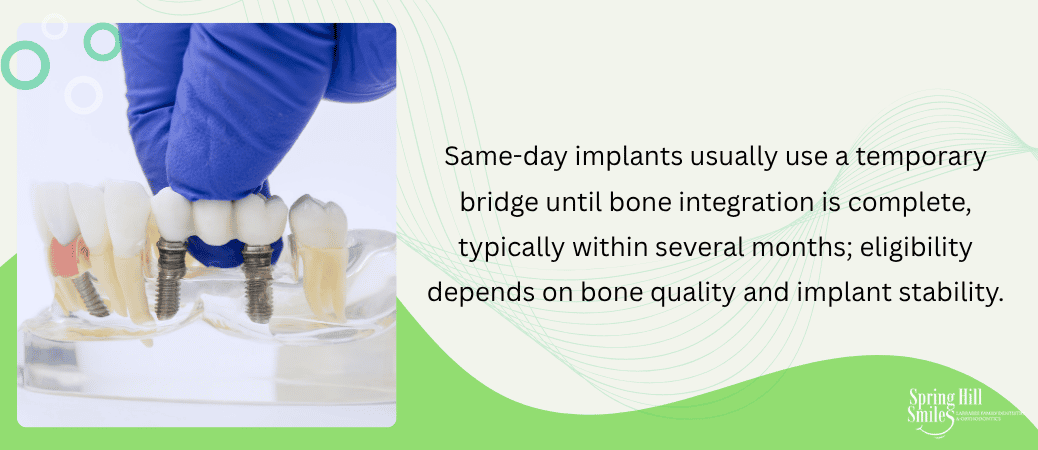
Usually not. Same-day teeth commonly refer to a temporary fixed bridge placed shortly after implant surgery when sufficient implant stability is achieved. The final restoration is typically fitted after the implants have healed, although treatment protocols can vary.
Your implants still need osseointegration, the process where bone grows tightly around the implant. Implant integration usually takes several months. During that time, you eat softer foods. After healing, the final bridge is made and fitted.
Not everyone qualifies for same-day temporaries. Soft bone or low implant stability can mean waiting. The same idea applies to crowns; you can compare same-day vs traditional crowns if your plan includes several.
What Should You Compare in Two Treatment Quotes?
All-on-X pricing is often quoted per arch. Reconstruction varies more because every tooth gets its own treatment. Two quotes only compare fairly if they include the same steps.
Check whether each quote includes:
- CBCT scan and planning
- Extractions and any grafting or sinus lift
- Number and type of implants
- Temporary teeth
- The final bridge material
- Sedation
- Follow-up visits and adjustments
Ask for an itemized treatment estimate so you understand what is included and what may cost extra. You can also review the available dental financial options to better understand payment arrangements before making your decision.
How Will You Clean and Maintain the Finished Teeth?
A reconstruction is cleaned much like natural teeth. You brush, floss, and visit for cleanings. Crowns and bridges need special floss threaders under them.
An All-on-X bridge stays in place, so daily cleaning focuses on the spaces beneath and around it using appropriate brushes, flossing aids, or a water flosser. Your dental team will assess whether professional bridge removal is necessary during maintenance visits.
Choose the Plan That Matches What Can Be Saved
Choose full-mouth reconstruction when most of your teeth have a healthy future, and choose All-on-X when an arch has too few strong teeth left to build on. Many people do best with a mix, one arch rebuilt and one replaced.
Before you decide, make sure you have:
- A CBCT scan and a tooth-by-tooth review
- A clear reason for every extraction
- An implant count tied to your bone and bite
- A written plan separating temporary and final teeth
At Spring Hill Smiles, our dental team evaluates the condition of your remaining teeth, jawbone, gums, and bite before recommending full mouth reconstruction or All-on-X. The goal is to preserve healthy natural teeth whenever appropriate while creating a stable, functional smile that supports your long-term oral health.
Frequently Asked Questions
Is full mouth reconstruction worth it if I can keep most of my teeth?
Yes, for most people it is. Keeping healthy roots preserves the natural feel of your bite and the bone around those teeth. It usually takes more visits, so plan for a staged process.
Would All-on-4 make sense if I still have several healthy teeth?
Usually not in that arch. All-on-4 requires removing every tooth in the arch, so healthy teeth would be lost. Ask whether crowns, bridges, or single implants could save them first.
Can I get All-on-X in one arch and reconstruct the other?
Yes, and this is common. Your upper and lower arches can be treated differently as long as they are designed to meet evenly. The bridge must be built to handle the force from natural teeth on the opposite jaw.
Does bone loss rule out All-on-X?
Not always. Angled implants, extra implants, grafting, or a sinus lift can make treatment possible in many cases. A CBCT scan shows how much bone you have and which approach fits.
What should I ask before agreeing to extractions or dental implants?
Ask why each tooth cannot be saved and what your other options are. Ask how many implants you need, whether grafting is likely, and what the quote includes.