
.png)
.png)
.png)
.png)

.png)
If you smoke and need to replace missing teeth, you might wonder whether dental implants are even an option for you. The good news is that smoking does not automatically disqualify you from being a candidate for dental implants, but it does come with some important considerations.
Smokers can get dental implants, but they face higher risks of complications and failure compared to non-smokers, with success rates around 85-90% versus 95% for non-smokers. Smoking affects how your body heals after surgery because nicotine reduces blood flow to your gums and jawbone. This slower healing process can lead to infections and other problems that threaten the implant.
Understanding these risks and knowing what steps you can take to improve your chances makes a big difference. Whether you decide to quit smoking temporarily, explore alternatives, or move forward with implants while taking extra precautions, having the right information helps you make the best choice for your dental health.
Key Takeaways
- Smokers can get dental implants but face increased risk of complications and lower success rates than non-smokers
- Quitting smoking before and after surgery significantly improves healing and reduces the chance of implant failure
- Alternative tooth replacement options exist for smokers who want to avoid implant risks or cannot quit smoking
Dental Implants and Smoking: What Patients Need to Know
Smoking affects every stage of the dental implant process, from your initial candidacy evaluation to the critical bone fusion that determines long-term success. Understanding how cigarettes interfere with implant placement helps you make informed decisions about your oral health.
How Dental Implants Work
Dental implants are small titanium posts that your dentist surgically places into your jawbone. They act as artificial tooth roots that support crowns, bridges, or dentures.
The procedure typically happens in stages. First, your dentist inserts the titanium post into your jawbone through a minor surgery. Over the next several months, your bone grows around the implant in a process called osseointegration.
Once the implant fuses with your bone, your dentist attaches an abutment (a connector piece) to the post. Finally, they place your custom-made crown or other restoration on top. The entire process usually takes three to six months, though it can vary based on your healing ability and whether you need additional procedures like bone grafting.
Immediate Impact of Smoking on Implant Candidacy
When you attend an implant consultation, your dentist will ask about your smoking habits. The answer can smokers get dental implants is yes, but smoking significantly increases your risk of complications and failure.
Tobacco use reduces blood flow to your gums and bones. This decreased circulation means less oxygen and fewer nutrients reach the surgical site. Your body needs these resources to heal properly after implant placement.
Success rates drop to 85-90% for smokers compared to higher rates for non-smokers. Heavy smokers who use more than 20 cigarettes daily face even greater challenges during the healing process.
Role of Osseointegration in Implant Success
Osseointegration is the most critical factor in determining whether your dental implant succeeds or fails. This biological process involves your jawbone cells growing directly onto the titanium implant surface, creating a strong, stable foundation.
Smoking disrupts osseointegration in several ways. Nicotine constricts your blood vessels, limiting the bone cells' ability to attach to the implant. Tobacco also weakens your immune system, making you more vulnerable to infections at the implant site.
The chemicals in cigarettes create an environment where bacteria thrive more easily. This bacterial growth can lead to peri-implantitis, an inflammatory condition that destroys the bone supporting your implant. Without proper bone integration, your implant may become loose or fail completely within the first few years.
Key Risks Smokers Face With Dental Implants
Smoking creates three major problems for dental implant patients. These include slower healing due to poor blood circulation, higher chances of developing serious gum infections around the implant, and significantly greater odds of complete implant failure.

Delayed Healing and Reduced Blood Flow
When you smoke, nicotine causes your blood vessels to narrow. This means less oxygen and fewer nutrients reach the area where your dentist placed the implant.
Reduced blood flow directly impacts how quickly your body can repair tissue after surgery. Your cells need proper circulation to rebuild the bone and gum tissue around the implant. The carbon monoxide in cigarettes makes this problem worse by binding to your blood's hemoglobin, which further limits oxygen delivery.
Your wound healing slows down significantly compared to non-smokers. The chemicals in tobacco can damage the small blood vessels around your implant for hours after each cigarette. This extended recovery period increases your risk of complications during the critical first few months when your jawbone needs to fuse with the implant.
Increased Risk of Peri-Implantitis and Infection
You face a much higher risk of developing peri-implantitis if you smoke. This serious condition causes inflammation and infection in the tissues surrounding your implant.
Smoking weakens your immune system's ability to fight bacteria around the implant site. Your white blood cells become less effective at protecting against infection. The chemicals in tobacco reduce the production of antibodies that normally defend against harmful bacteria.
Research shows smokers are 2.14 times more likely to experience early implant failure compared to non-smokers. Peri-implant mucositis often appears first as inflammation in the soft tissues. If you continue smoking, this can progress to full peri-implantitis, which damages the bone supporting your implant and becomes harder to treat.
Higher Rates of Implant Failure
Smokers experience failure rates reaching up to 15.8% versus just 1.4% in non-smokers. This stark difference shows how tobacco use directly threatens your implant's survival.
Implant failure can happen during the early healing phase or years later. Studies show that smokers face a 140.2% higher risk of implant failure compared to people who don't smoke. The more cigarettes you smoke per day, the greater your risk becomes.
Your jawbone struggles to properly fuse with the titanium implant post when you smoke. This process, called osseointegration, is essential for long-term stability. Without successful bone integration, your implant can become loose or fall out completely within months of placement.
Assessing Jawbone and Gum Health Before Implant Surgery
Your dentist needs to check your jawbone density and gum condition before placing implants, especially if you smoke. These evaluations help determine whether your mouth can support implants or if you need additional treatment first.
Importance of Jawbone Density
Your jawbone needs enough strength and thickness to hold an implant in place. Smoking reduces bone density over time because nicotine limits blood flow to your jaw. This means less oxygen and nutrients reach the bone tissue.
Your dentist will take X-rays or CT scans to measure your bone density. They look for areas where the bone might be too thin or weak. If you've been smoking for many years, you may have lost bone mass without even knowing it.
The minimum bone height needed varies by location in your mouth. Front teeth typically need at least 10mm of bone height, while back teeth may require 8-10mm. Your bone width should be at least 5-6mm to support a standard implant safely.
Periodontal Disease and Its Impact
Smoking increases your risk of gum disease, which directly affects implant success. Periodontal disease causes inflammation and infection in the gums and bone around your teeth. This weakens the foundation that implants need to stay stable.
Your periodontist will check for signs of gum disease during your evaluation. They measure the depth of pockets between your gums and teeth. Pockets deeper than 4mm often indicate infection.
Active gum disease must be treated before you can get implants. Your dentist may recommend deep cleaning, antibiotics, or other treatments. Getting implants with untreated periodontal disease significantly raises your chance of failure.
Bone Grafting for Smokers
If you don't have enough jawbone, your dentist may suggest bone grafting to build up the area. This procedure adds bone material to your jaw to create a stronger base for the implant. The graft can come from your own body, a donor, or synthetic materials.
Bone grafting takes longer to heal if you smoke. The added bone needs 3-6 months to integrate with your natural jawbone. Smoking during this time slows down healing and can cause the graft to fail.
Your success rate with bone grafts drops if you continue smoking. Some dentists require you to quit smoking before they'll perform a bone graft. Others may recommend waiting until you can reduce your smoking significantly.
Steps Smokers Can Take to Improve Implant Success
Taking the right steps before and after your dental implant surgery can make a real difference in your outcome. Quitting or cutting back on smoking, using nicotine alternatives, keeping your mouth clean, and staying committed to regular dental visits are the most important actions you can take to protect your investment.
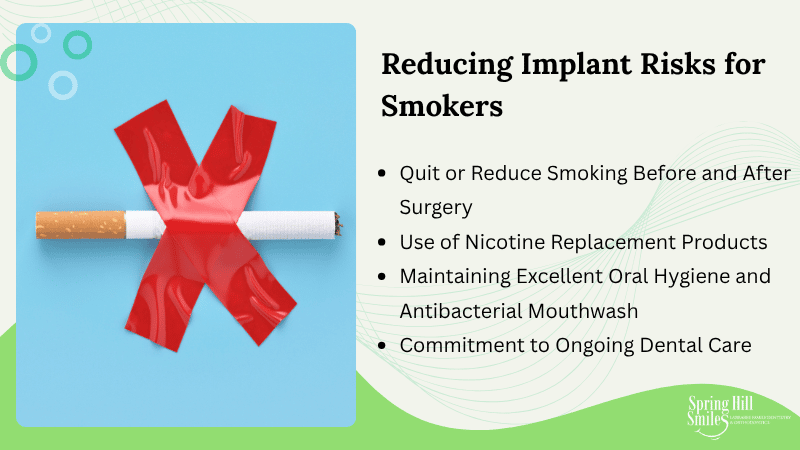
Quit or Reduce Smoking Before and After Surgery
The best thing you can do for dental implants for smokers is to quit tobacco completely. Even stopping just before surgery helps your body heal better.
If you can't quit entirely, try to reduce how much you smoke. Every cigarette you don't smoke improves blood flow to your gums and jaw. Better blood flow means more oxygen and nutrients reach the implant site.
Most dentists recommend stopping at least two weeks before surgery. After surgery, you should avoid smoking for at least 2-3 months while the implant bonds to your bone.
Research shows that the more cigarettes you smoke each day, the higher your risk of implant failure. Cutting back even a little can improve your chances of success.
Use of Nicotine Replacement Products
Nicotine replacement options like patches, gum, or lozenges can help you manage cravings without the harmful effects of smoking. These products deliver nicotine without the toxins found in cigarette smoke.
Patches work well because they don't touch your mouth or the surgical site. Nicotine gum and lozenges are also options, but use them carefully to avoid irritating healing tissues.
Talk to your dentist before using any nicotine replacement product. They can recommend the best option based on your specific situation. While nicotine itself can still affect blood flow, it's much less harmful than smoking cigarettes during your recovery period.
Maintaining Excellent Oral Hygiene and Antibacterial Mouthwash
Keeping your mouth clean is critical for implant success. Brush gently around the surgical site at least twice a day. Use a soft-bristled toothbrush to avoid damaging healing tissues.
Your dentist may recommend using antibacterial mouthwash to reduce bacteria and prevent infection. Rinse as directed, usually two to three times daily during the healing period.
Don't skip flossing once your dentist says it's safe. Food particles and bacteria can build up around the implant and cause problems. Be gentle but thorough when cleaning around the implant site.
Commitment to Ongoing Dental Care
Regular dental visits are essential for long-term implant success. Your dentist needs to monitor the implant and check for early signs of problems like gum disease or bone loss.
Schedule professional cleanings every three to six months. These appointments allow your dental team to remove buildup you can't reach at home and spot potential issues early.
Stay honest with your dentist about your smoking habits. They can adjust your treatment plan and give you specific advice based on your situation. If you notice any pain, swelling, or looseness around your implant, contact your dentist right away.
Alternatives to Dental Implants for Smokers and High-Risk Patients
Some smokers and high-risk patients are not good candidates for implants due to poor bone quality, active gum disease, or very high failure risk. Dental bridges and partial dentures can restore function and appearance when implants are not a safe option.
When Implants Are Not Viable
Your dentist may recommend against implants if you have severe bone loss that cannot be corrected with grafting. Heavy smoking combined with uncontrolled diabetes or active gum disease also creates a very high failure risk.
If you have been told your jawbone density is too low, implants may not integrate properly. The implant needs solid bone to fuse with during healing. Without enough bone, the implant can fail even with grafting.
Active periodontal disease must be treated and controlled before any tooth replacement. If your gums are infected or inflamed, placing an implant will likely fail. Your dentist will want to see stable gum health for several months first.
Some patients choose to avoid implants after learning about the doubled failure rates and extended healing times. Understanding these risks helps you make an informed choice about whether the investment is worth it.
Other Tooth Replacement Options
Dental bridges attach to the teeth on either side of the gap. Your dentist prepares those adjacent teeth by removing some enamel, then places crowns connected to a false tooth in between. Bridges last 5 to 15 years and cost $2,000 to $5,000 per unit.
Bridges work well for smokers because they don't require bone integration. They stay in your mouth permanently and feel similar to natural teeth.
Partial dentures are removable appliances that replace one or more missing teeth. They clip onto your remaining natural teeth with metal clasps. Partials cost $700 to $3,000 and need replacement every 5 to 8 years.
Complete dentures replace all teeth in the upper or lower arch. They rest on your gums and stay in place through suction or adhesive. Full dentures cost $1,300 to $3,000 per arch.
Dentures require adjustment as your jawbone changes shape over time. You remove them daily for cleaning.
Long-Term Maintenance and Monitoring for Smokers With Implants
Smokers with dental implants face higher risks of complications like bone loss and infection around the implant. You need to follow stricter maintenance routines and attend more frequent dental visits to protect your investment.

Preventing Peri-Implantitis After Surgery
Peri-implantitis is an infection that affects the gum and bone around your dental implant. Smoking significantly increases your risk of developing this condition because it reduces blood flow to your gums.
You should brush your implants twice daily using a soft-bristled toothbrush. Pay special attention to the area where the implant meets your gum line.
Floss around your implants at least once per day using unwaxed tape or implant-specific floss. Water flossers can also help remove bacteria from hard-to-reach areas.
Use an antimicrobial mouth rinse as recommended by your dentist. This helps control bacterial growth around your implants. Avoid alcohol-based rinses that can dry out your mouth and irritate healing tissues.
Warning Signs of Implant Problems
You need to watch for specific symptoms that indicate your implant may be failing. Bleeding gums around your implant are often the first sign of trouble, especially if they bleed when you brush or floss.
Swelling or redness around the implant site means infection may be present. Pain or discomfort near the implant that doesn't go away after the initial healing period requires immediate attention.
Key symptoms to monitor:
- Loose implant or crown movement
- Pus or discharge around the implant
- Bad taste in your mouth near the implant
- Visible bone loss or gum recession
- Difficulty chewing on the implant side
Contact your dentist right away if you notice any of these signs. Early treatment can sometimes save an implant that's starting to fail.
Regular Professional Checkups
You should visit your dentist every three to four months instead of the standard six-month schedule. Smokers require more frequent monitoring because complications develop faster.
Your dentist will measure pocket depths around your implants to check for bone loss. They'll also take X-rays to see if the bone supporting your implant remains stable. Professional cleanings remove hardened plaque that you can't eliminate at home.
These visits let your dental team catch problems early when they're easier to treat. Studies show that regular maintenance significantly improves long-term success rates for implants in smokers.
Frequently Asked Questions
Smoking creates unique challenges for dental implant patients, from slower healing to higher failure rates. Understanding the specific risks and timeline recommendations helps you make informed decisions about your treatment.
How does smoking affect the healing and bonding process after getting dental implants?
Smoking reduces blood flow to your gums and jawbone. This means less oxygen and fewer nutrients reach the implant site during the critical healing period.
Your body needs strong blood flow to build new bone around the implant. This process is called osseointegration. When you smoke, your body struggles to complete this bonding process effectively.
Nicotine also weakens your immune system. This makes it harder for your body to fight off infections at the surgical site.
The chemicals in tobacco smoke can damage the soft tissue around your implant. This tissue damage can lead to inflammation and slower wound closure.
What are the failure rates of dental implants for smokers compared with non-smokers?
Non-smokers typically see success rates around 95 percent. Smokers have lower success rates, usually between 85 and 90 percent.
This means failure rates roughly double for smokers compared to non-smokers. The difference comes from the biological effects tobacco has on healing and bone integration.
Heavy smokers face even higher risks. If you smoke more than one pack per day, your failure rate increases further.
The longer you have smoked, the more it affects your bone density and tissue health. These factors contribute to the overall risk of implant failure.
How long should I stop smoking before and after dental implant surgery to improve success?
Most dental specialists recommend stopping all tobacco and nicotine products at least two weeks before your surgery. This gives your blood vessels time to recover and improves circulation to your jaw.
After surgery, you should avoid smoking for at least eight weeks. This covers the most critical healing period when bone grows around the implant.
Some specialists recommend even longer quit periods. The more time you give your body without tobacco, the better your chances of success.
Quitting permanently gives you the best possible outcome. Even if you restart smoking later, avoiding it during the healing window significantly improves your results.
If I smoked shortly after implant surgery, what warning signs should I watch for?
Watch for increased pain or swelling that gets worse instead of better. These can be signs that healing is not progressing normally.
Bleeding that continues beyond the first few days is another warning sign. Normal surgical sites should stop bleeding within 24 to 48 hours.
Look for signs of infection like pus, bad odor, or a fever. Smoking increases your infection risk, so stay alert to these symptoms.
If you notice the implant feels loose or moves when you touch it, contact your dentist immediately. This could mean the implant is not integrating with your bone.
Any unusual taste or drainage from the surgical site deserves attention. Call your dental provider right away if you notice any of these warning signs.
Are All-on-4 dental implants a good option for smokers, and do the risks differ?
All-on-4 implants replace a full arch of teeth using four strategically placed implants. The same smoking risks apply to this treatment as to single implants.
The risks may actually be higher with All-on-4 because the entire restoration depends on just four implants. If even one implant fails, it can compromise the whole system.
Smokers considering All-on-4 need very careful evaluation by a specialist. Your bone quality and density matter even more when supporting a full arch of teeth.
The cost is also a bigger consideration. All-on-4 treatment typically ranges from $15,000 to $30,000 per arch. If an implant fails, the cost to repair or redo the work is substantial.
Your dentist may require you to quit smoking completely before approving All-on-4 treatment. The investment is too large to risk on patients who continue tobacco use.
What are the best alternatives to dental implants for smokers who can't quit right now?
Dental bridges are a common alternative that does not require surgery or bone integration. A bridge uses your existing teeth as anchors to support replacement teeth.
Bridges work well if you have strong, healthy teeth on both sides of the gap. The procedure is faster than implants and does not depend on bone healing.
Removable partial dentures are another option for replacing one or several teeth. They clip onto your existing teeth and you can take them out for cleaning.
Full dentures replace all teeth in an arch and rest on your gums. Modern dentures look natural and function better than older versions.
These alternatives depend on your oral health, bone condition, and personal needs. A detailed dental exam will help determine which option works best for you.
Keep in mind that bridges and dentures also last longer when you do not smoke. Tobacco affects all types of dental work, not just implants.
.png)
.png)





.webp)